Reviewed · MADRID TOURS
La Latina to Madrid Guided Tour with Breakfast
Madrid’s story is written not just in palaces and plazas, but in the narrow lanes between them. This 2.5-hour walk starts over coffee and homemade carrot cake in La Latina, then links four distinct districts, from old tenement courtyards and market stalls to the grand center of Habsburg Madrid.
I like two things in particular: breakfast gives the group an easy, sociable start, and the route balances famous landmarks with neighborhood streets where daily life still plays out. Guide Francisco is named in one account, and the tour’s small-group cap is 25, with the possibility of a much smaller group.
One consideration: the route covers a lot of ground in a short time. Treat the churches, palace and other landmarks as a guided introduction, not as a series of long visits indoors. Admission is listed as free at the stops, and the tour is designed to keep moving.
Key points to know
- Coffee and carrot cake start the morning at the meeting point on Mesón de Paredes.
- Four districts shape the walk: La Latina, Lavapiés, Las Letras and the Austrias.
- Markets bring the route down to street level, especially Antón Martín and San Miguel.
- The historic stops are brief: most are listed at about five minutes, with ten minutes at Galería Canalejas.
- Francisco is one named guide, though the guide may vary on your date.
- The listed price is $63.62 per person for an experience lasting about two and a half hours.
A breakfast table in La Latina sets the tone
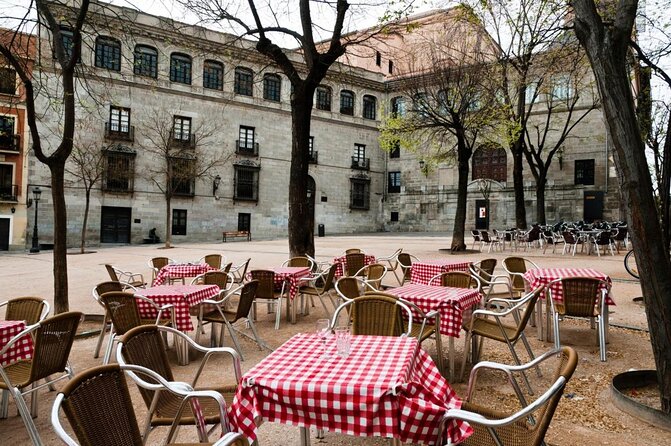
Meet at C. del Mesón de Paredes, 11, at 11 a.m. The tour begins with coffee and a slice of homemade carrot cake, a simple but useful icebreaker before setting off. It gives you a moment to meet the guide and the others, and helps the walk feel more like an introduction to the neighborhood than a race to the first monument.
La Latina’s street plan is part of its appeal. Its narrow, winding lanes grew out of a medieval layout, so they do not follow the neat grid you might expect in a newer district. Streets often open onto small squares, making the route feel like a sequence of discoveries rather than a straight march.
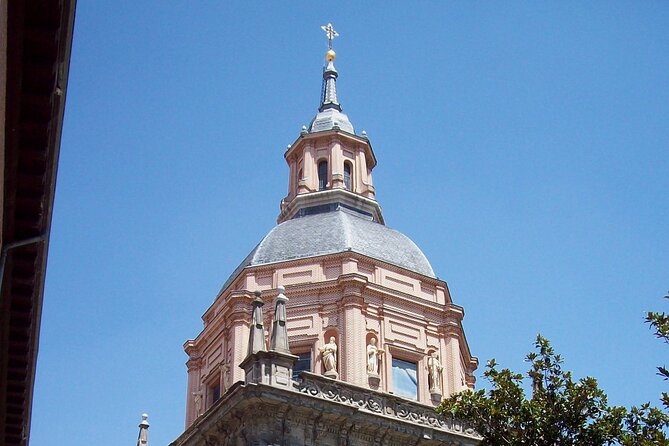
The first named stop is Iglesia Parroquial de San Millán y San Cayetano. The church was begun in 1669 by architect Marcos López and completed in 1761 by Francisco de Moradillo. The design is also associated with José de Churriguera and Pedro de Ribera. The stop is listed for five minutes, so expect a short look and an explanation, not a full church visit.
From there, the walk heads toward Tirso de Molina Square, where flower stalls add a splash of color. The upper part of the neighborhood is also known for clothing and accessories wholesalers, some of which sell to individual shoppers. That mix of trade and local life helps explain why La Latina is more than a picturesque backdrop.
Lavapiés reveals Madrid’s working-class past
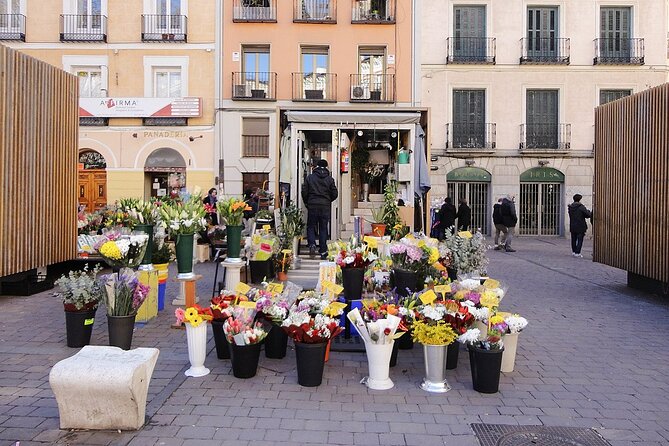
The second district is Lavapiés, a neighborhood with a long working-class history. Since the sixteenth century, many residents lived in corralas, apartment buildings arranged around a shared interior courtyard. The layout offered a close-knit form of city living, and it remains a useful way to picture how people once made a home in densely packed central Madrid.
The route’s market stop is Mercado de Antón Martín. It combines traditional food stalls with restaurants serving Spanish, Italian, Asian and Latin American food. The market has also adapted to the current appetite for gourmet food halls, so you can see old-fashioned market trade alongside places geared toward a quick meal.
Five minutes is the listed time here, which makes this a taste of the market rather than a proper lunch break. If you want to shop or sit down for food, plan to return on your own. Still, even a brief visit gives you a sense of how markets continue to serve as neighborhood meeting places, not just attractions.
Lavapiés is one of the parts of the walk I’d value most if you want more than a parade of grand buildings. The background on the corralas gives the streets a human scale. It also offers a contrast with the polished shopping district and royal landmarks later in the route.
More guided departures around Madrid:
- Madrid: Royal Palace Expert Guided Tour with Skip-the-Line
★ 4.7 · 6,986 reviews - From Madrid: Guided Day Trip to Toledo by Bus
★ 4.1 · 5,280 reviews - Madrid: Toledo & Segovia Full Day Guided Tour with Alcázar
★ 4.6 · 4,394 reviews
Las Letras connects streets with Spain’s literary greats
Next comes Las Letras, or the Literary Quarter. In the seventeenth century, during Spain’s Golden Age of literature, writers including Cervantes, Lope de Vega, Quevedo, Tirso de Molina and Góngora lived in this area. The neighborhood’s name and street references keep that literary past visible in the city.
The tour then reaches Galería Canalejas, a luxury shopping center in the former Palacio de la Equitativa, between Calle Alcalá and Calle Sevilla. The restored building now houses more than 40 high-end boutiques, including brands such as Hermès, Cartier and Rolex, as well as restaurants and food concepts associated with Michelin-star chefs.
This is a sharp change of scene from the markets and winding lanes. It gives the route a modern counterpoint, though the stop is listed at ten minutes and no admission is included. Think of it as a chance to see how Madrid reuses a historic building for contemporary luxury, rather than time to browse the shops or eat.
A short walk brings you to Puerta del Sol, one of the city’s best-known junctions. Streets including Mayor, Arenal, Alcalá and Preciados meet here, and the square is also the starting point for Spain’s major radial roads. It is a natural place to understand how Madrid’s center connects to the rest of the country, as well as a good orientation point for your own later wandering.
Habsburg Madrid brings the grand landmarks
The route moves into the Austrias, the oldest part of central Madrid and the area most closely associated with Habsburg rule. Its grand central square is a good place to pause and take in the change in scale. The open terraces, time-honored shops and street performers create a lively public space, while seasonal events include an Easter drum parade, outdoor concerts and a Christmas market.
The description of the square does not name it, but the walk continues through the historic center toward several of Madrid’s major monuments. Keep in mind that these are brief orientation stops. A five-minute visit at a church or landmark is enough to hear the basic story and get your bearings, but not enough for a thorough look inside.
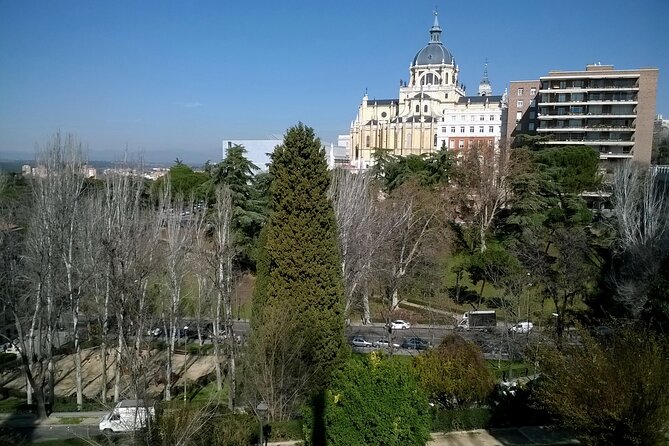
Catedral de Santa María la Real de la Almudena has a surprisingly complicated origin. Francisco de Cubas drew up plans in 1879 for a church intended as a pantheon for Queen Maria de la Mercedes. After the Madrid-Alcalá bishopric was established in 1885, the plans changed to create a cathedral. Its long development makes it a useful reminder that Madrid’s religious landmarks often carry more recent stories than their historic setting might suggest.
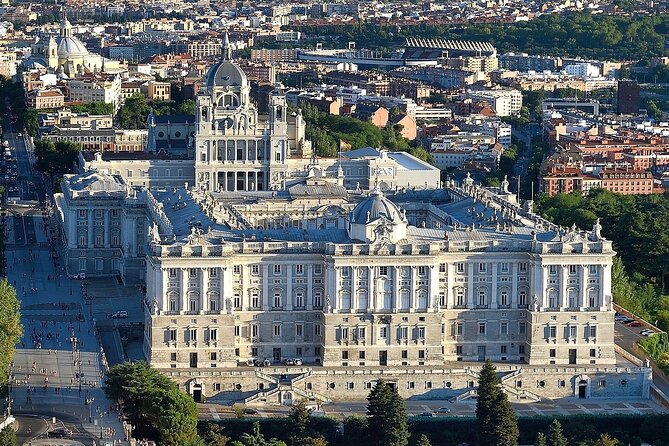
The route also passes the gardens near the Palacio Real. The 1.6-hectare gardens were planned under José Bonaparte, with the aim of framing the palace and Teatro Real. They later received major restoration work, including a significant project led by Miguel de Oriol in 1997. The stop lets you see how green space was used to shape the royal setting.
Nearby, the Royal Palace offers another major chapter in Spain’s royal history. It served as home to kings from Charles III to Alfonso XIII, and remains the monarchy’s official residence, though it is no longer the royal family’s home. The tour does not list a palace admission or a lengthy visit, so plan a separate ticketed visit if exploring the interior is a priority.
Mercado de San Miguel is a fitting finish
The walk ends at Mercado de San Miguel, close to Plaza Mayor. Opened in 1916 as a local food market, it became Madrid’s first gourmet market in 2009 and relaunched in 2018 with internationally known chefs. Its cast-iron structure is part of the appeal, and the food stalls make it a handy place to continue your day.
The market is a natural endpoint because it ties together two threads of the tour: Madrid’s everyday food culture and its changing city center. You can choose to stay for a bite or use the nearby streets to continue exploring. No meal is included beyond the opening coffee and cake, so budget separately if you plan to eat here.
The route’s broad sweep is both its strength and its limit. You get a clear sense of how one central district differs from the next, and you hear the history attached to churches, markets and royal spaces. But with four districts and numerous landmarks packed into about two and a half hours, this is an overview, not a deep study of any one neighborhood.
A few more tours around Madrid worth booking
- Madrid: Tour Bernabéu Entry Ticket
★ 4.5 · 21,573 reviews - Madrid: Prado Museum Entry Ticket
★ 4.6 · 17,509 reviews - Madrid: Royal Palace Fast-Access Admission Ticket
★ 4.6 · 13,856 reviews - Madrid: “Emociones” Live Flamenco Performance
★ 4.8 · 12,866 reviews
What the price buys you
At $63.62 per person, this is not simply a coffee stop with a stroll attached. You are paying for a guided route that connects several districts and provides historical context that can be hard to gather from a map alone. The breakfast adds a personal start, while the markets and side streets help balance the famous sights.
Value depends on how you like to explore. If you want a guide to make sense of Madrid’s layout and give you a list of places to revisit, the price is easier to justify. If your main aim is to enter the Royal Palace, spend time shopping or linger over lunch, the short stops mean you may prefer to book separate visits and explore at your own pace.
Group discounts are available, and the maximum group size is 25. One person described ending up as the only party on the tour, which suggests a small group is possible, but it is not something you can count on. Francisco led that outing and began with coffee and breakfast; his name is a useful detail, but guide assignments can change.
The available feedback gives particular emphasis to the guide’s warmth, clear communication and the history and fun facts shared along the route. That matches the tour’s strongest promise: a personable introduction to Madrid rather than a string of disconnected photo stops. The feedback is limited, though, so it is best to judge the experience by its route, pace and price rather than assume every departure will be identical.
Who should book this Madrid walk
I’d choose this tour if you are new to Madrid and want a compact orientation before exploring on your own. The mix of neighborhood streets, food markets and major landmarks gives you several useful reference points in one morning. It should also suit you if you enjoy local context and want to understand the city beyond its best-known monuments.
It is less suited to anyone who wants long visits inside buildings or unhurried time at every stop. The route includes many places, but the listed stop times are short. If you have a particular interest in the cathedral, palace, literary sites or markets, use the walk to get oriented, then return for a closer look.
The meeting point is near public transportation, and most people can participate. The tour starts at 11 a.m., lasts about two and a half hours and ends at Mercado de San Miguel. Free cancellation is available up to 24 hours before the start time; changes or cancellations inside that window are not accepted.
My call: book it for a friendly, wide-angle introduction to central Madrid, especially if coffee, neighborhood history and markets sound as appealing as the grand landmarks. Skip it if you want a slow, detailed tour of interiors. The best plan is to use the walk to find your bearings, then choose one or two places to revisit at your own pace.
FAQ
How long is the La Latina to Madrid Guided Tour with Breakfast?
It lasts approximately two hours and 30 minutes.
What time does the tour start?
The start time is 11 a.m.
Where does the tour meet?
It meets at C. del Mesón de Paredes, 11, in Madrid.
Where does the tour end?
It ends at Mercado de San Miguel, at Plaza de San Miguel.
Is breakfast included?
The tour begins with coffee and a portion of homemade cake, described as carrot cake.
Which neighborhoods are included?
The route covers La Latina, Lavapiés, Las Letras and the Austrias.
How much does the tour cost?
The listed price is $63.62 per person. Group discounts are available.
How many people can join the tour?
The maximum group size is 25 people.
Can I cancel for a refund?
Yes. You can cancel up to 24 hours before the experience starts for a full refund. Cancellations or changes made less than 24 hours before the start time are not accepted.
Just added in Madrid
- Prado and Reina Sofia Museums Private Tour★ 5.0 · 6 reviews
- Prado Museum and Royal Palace Private Tour★ 5.0 · 18 reviews
- Prado Museum VIP Tour with Drinks & Tapas★ 5.0 · 4 reviews
- Prado Museum and Royal Palace Private Tour in Madrid★ 5.0 · 3 reviews
- Prado Museum Private Tour★ 5.0 · 62 reviews
- Prado Museum and Reina Sofia Museum Private Tour★ 4.5 · 6 reviews
- Visita privada al Museo del Prado★ 5.0 · 34 reviews
- Prado Museum Private Tour with Tickets Included★ 5.0 · 3 reviews
Madrid Tours, compared.


Live Flamenco Show with Food and Drinks Options
Read our review →
Avila & Segovia Tour with Tickets to Monuments from Madrid
Read our review →